ISSUE 77 | JULY 2025
AN OFFICIAL NEWSLETTER OF THE FEDERATION OF UGANDA EMPLOYERS
FUENEWS
THE VOICE OF EMPLOYERS
FUE CEO MESSAGE

Dear Esteemed Member,
In accordance with the FUE Constitution 2022, the secretariat convened the Governing Council (GC) induction for newly elected members of the board that were voted into office during the 46th Annual General Meeting. Mr. Fred K Bamwesigye and Ms. Mona Muguma Ssebuliba, the Chairperson and Vice-Chairperson respectively led the proceedings of the meeting to provide insight for the GC on the scope of their work at the helm of the Federation. The FUE
board provides oversight and strategic direction to work operations in addition to establishing committees for specific purposes, formulating policies, approving the financial statements, strategic plans, annual workplans, budgets and other related documents. We wish the team a fruitful tenure of service in their dedicated service to the advancement of the Employers fraternity.
According to study conducted by the Uganda Business and Technical Examination Board (UBTEB), there is a steady growth of interest in Technical Vocational Education and Training (TVET) programs, with the cumulative annual record of registered candidates increasing from 9,198 in 2012 to 39,048 in 2022 with at least 295,760 students graduating in TVET programs since 2012. In light of this development, the TVET Act 2025 was assented to in January and commenced in March, a notable milestone for the education sector.
Furthermore, we are delighted to partner with Industriall National Coordinating Council to strengthen collaborative approach to facilitate the domestication of Convention 190 (C190) that was ratified by the Government of Uganda in 2023. This milestone is significant to ensure Employers have workplaces free of violence and harassment to promote employee wellbeing, maximise workforce productivity and advance business growth. We are keen on working with relevant stakeholders to formulate policies, adopt best practices and ensure the world of work upholds international labour standards in the course of employment.
Save the date for the Employer of the Year Awards (EYA) Dinner slated for Thursday 11th September 2025 at Mestil Hotel from 5:00pm(EAT).
Thank you,
Together for Employers.
Douglas Opio
The Chief Executive Officer, FUE
CONTENTS
- FUE CEO Message
- FUE Governing Council Board Induction
- FUE Elected to TVET Council
- FUE-IndustriALL Partnership
- Sub-Regional Workshop On Decent Work Country Programmes
- FUE Industrial Relations Clinic
- The Corporate Responsibility to Respect Human Rights
- Call for Participation in the Salary Survey
- FUE Staff Commentary
- Upcoming Events


FUE GOVERNING COUNCIL BOARD INDUCTION

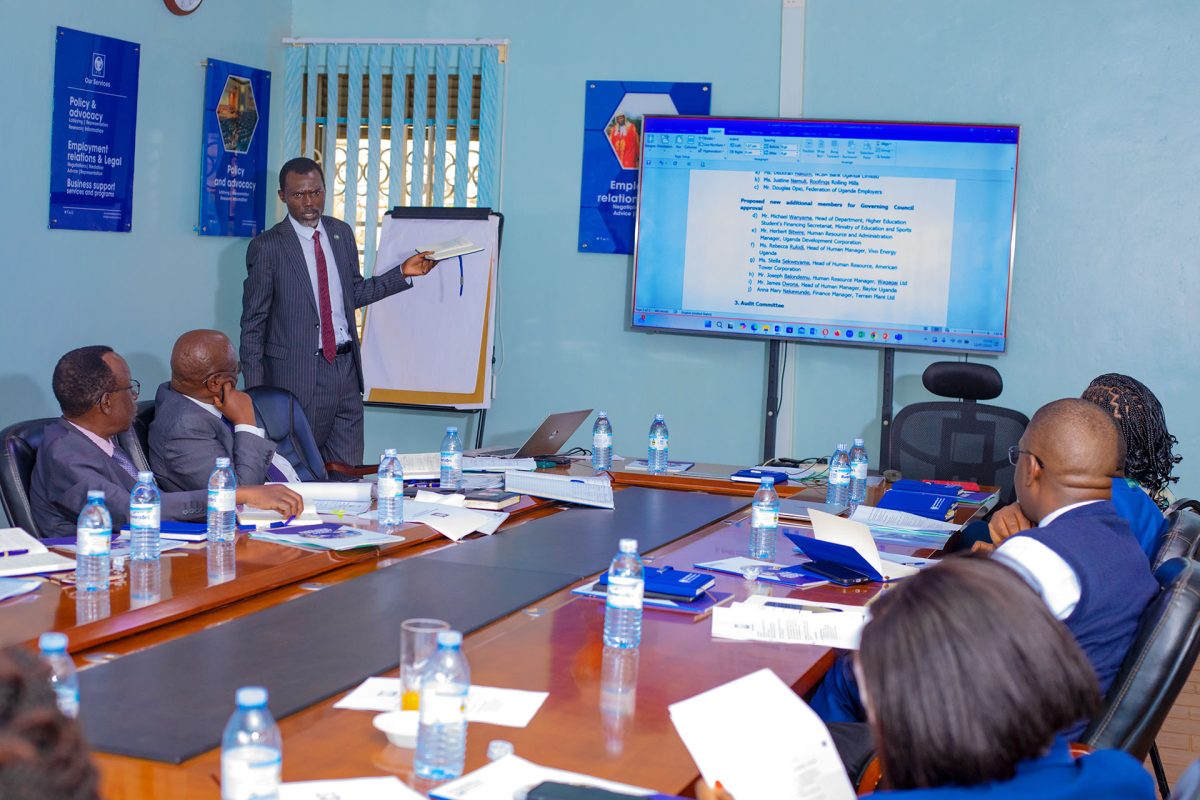
At the FUE 46th Annual General Meeting, we elected a new Governing Council board to provide oversight and strategic direction to the activities of the Federation. On Tuesday 15th July, we convened the board induction to share pertinent details on the activities, programs and work of the Federation to ease the work of the Governing Council. The meeting was led by the Chairperson, Mr. Fred K Bamwesigye, the Director General Uganda Civil Aviation Authority and Ms. Mona Muguma Ssebuliba the Vice-Chairperson and CEO of aBi Finance Ltd.
The induction entailed aspects of sharing the FUE Strategic Plan, overview of the scope of FUE work and the role of the board members in strengthening the Employers fraternity. The board members include National Water and Sewerage Corporation (NWSC), Uganda Revenue Authority(URA), Uganda Christian University(UCU), Uganda Communications Commission (UCC), Uganda Insurers Association (UIA), Hariss International, Brighter Monday Uganda (BMU), National Union of Disabled Persons of Uganda (NUDIPU), National Information Technology Authority Uganda (NITA-U), Housing Finance Bank, Brookside Limited, Alliance of Bioversity International and CIAT, Vision Group, Mt. Elgon Hospital, Joint Clinical Research Centre, Foundation Leads, Amref Health Africa, Kakira Sugar and Terrain Plant Ltd. This team comprises of members across all categories hence representing all Employers in the membership base.
During the induction, the Governing Council pledged their commitment to working with FUE to serve Employers interests and needs at local, regional and international level to create a conducive business environment and advance economic growth.
We look forward to working with the new leadership team a fruitful tenure of service.


FUE ELECTED TO TVET COUNCIL

The Technical Vocational Education and Training (TVET) Act, 2025 was assented to on 27th January and it commenced on March 15th 2025 to provide the institutional framework for the coordination, regulation and promotion of TVET, the establishment of the TVET Council and Sector Skills Expert Committee, regulation of TVET providers, management and governance structures of TVET providers, to foster registration and licensing of TVET trainers, to develop the TVET qualifications framework and curricula as well as the formation of TVET assessment boards.
Due to this, the TVET council was constitiuted with seasoned business professionals with expertise to champion the evolution of technical education. On 4th July 2025, the TVET Council was inaugurated by the Minister of Education, Mrs. Janet Museveni at State House Nakasero. Our Chief Executive Officer, Mr. Douglas Opio was appointed as a member of the council chaired by Allen Kagina. This council will oversee policy, financing and licensing of private institutions in technical and vocational education. It will further manage the broader operations and quality assurance of the sub-sector.
As the premier voice of Employers on social and economic issues in Uganda, this landmark appointment is significant to ensure TVET institutions provide employable skills to thrive in the evolving labour market. It also provides the opportunity to lobby for favorable policies to streamline vocational training at national level. By investing in TVET, Uganda aims to produce a skilled workforce that can drive economic growth, reduce poverty, and improve living standards.
We believe TVET provides vital skills to foster job creation, facilitate skills development and advance economic growth. FUE is keen on working with various stakeholders such as the Government of Uganda, the private sector and education institutions to adopt an Employer-led TVET program.

FUE-INDUSTRIALL PARTNERSHIP


The Republic of Uganda deposited the instrument of ratification of the Violence and Harassment Convention 2019 (No 190) with the Director-General of the ILO On 7th August 2023. By submitting the instrument of ratification, Uganda became the 32nd country in the world, and the 8th country in Africa, to ratify C190. This is a landmark instrument and the first international labour standard to address violence and harassment in the world of work.
As a key stakeholder on labour and employment matters, we signed a Memorandum of Understanding (MOU) with Industriall National Coordinating Council on 17th July 2025. The MOU is an avenue to strengthen the collaborative approach to facilitate the domestication of C190. This will provide invaluable opportunities to eliminate violence and harassment in the world of work to foster good industrial relations, promote employee wellbeing and advance decent work for all.
Employers are called upon to acquaint themselves with the parameters of C190 to streamline work processes in line with the international labour standard. We look forward to a fruitful collaboration.
SUB-REGIONAL WORKSHOP ON DECENT WORK COUNTRY PROGRAMMES
As the sole Employers organisation in Uganda, we participated in the Tripartite Sub-Regional Workshop on Decent Work Country Programmes (DWCPs) and Country Programming organised by the International Labour Organisation (ILO) from Wednesday, 23rd to Thursday 24th July 2025 at Mount Meru Hotel in Arusha, Tanzania. Participants included representatives of governments, employers’ organisations and workers’ unions from the five East African countries under the ILO’s Dar es Salaam Office for East Africa i.e. Tanzania, Uganda, Kenya, Rwanda, and Burundi as well as ILO officials, the United Nations High Commission for Human Rights, United Nations Resident Coordinator among others. The aim of the workshop was to enhance national and regional capacities for the design, implementation, monitoring, and reporting of Decent Work Country Programmes in alignment with ILO programming principles and the United Nations Sustainable Development Cooperation Frameworks (UNSDCFs).
Key Points from the Workshop;
- The Decent Work Country Programmes (DWCP) is a national framework document facilitated by ILO to guide its work in alignment with the national priorities of a specific country.
- ILO does not provide dedicated funding for the implementation of a country specific projects but supports constituents or tripartite stakeholders (Government, Employers and Workers’ Unions) in resource mobilisation efforts.
- The Results-Based Management (RBM) approach is integral to ILO project planning and implementation and constituents have been encouraged to use the same approach.
- Since the Decent Work Country Programme does not come with automatic resources, active mobilisation of funds by a particular country is required for the successful implementation of its DWCP.
- In order to create an effective coordination and funding alignment, the Decent Work Country Programme should be aligned with the Sustainable Development Goals (SDGs) and the United Nations Sustainable Development Cooperation Frameworks.
- Capacity building among tripartite stakeholders is required in order to effectively engage and foster ownership of the Decent Work Country Programme and its implementation.
Country Specific Action Plan for Uganda: The priorities identified for follow-up activities
- Extend stakeholders engagement, promotion of evidence-based planning and monitoring, plus ensuring the tripartite stakeholders’ ownership of the Decent Work Country Programme.
- Align the Decent Work Country Programme with the National Development Plans and the United Nations Sustainable Development Cooperation Frameworks (UNSDCF).
- Put emphasis on diversified funding sources, including Public Private Partnership (PPP) and global initiatives like the global accelerator.
- Strengthening accountability, operational efficiency and reducing leakages are very critical aspects for the successful implementation of the DWCP.
- Appoint dedicated Decent Work Country Programme focal persons from the tripartite stakeholders.
- Promote joint resource mobilisation efforts between the ILO and the tripartite constituents (government, employers and workers).
- Build internal capacity through training, coaching, and knowledge-sharing to enhance understanding and ownership of DWCP among the tripartite constituents.
- Strengthen coordination through formal mechanisms like national committees and inclusive, transparent consultations.
- Leveraging digital tools for communication, feedback and wider engagement of relevant stakeholders.
- Encourage strong partnerships among tripartite partners for joint resource mobilisation and implementation.
- Promoting visibility of joint programmes and coordinated advocacy for the DWCP.
- Expanding stakeholders’ engagement, including through Public-Private Partnerships.
- Enhancing collaboration with institutions responsible for coordinating the United Nations Sustainable Development Cooperation Frameworks.
- Ensure timely and well-structured planning and implementation (of DWCP activities) for the system effectiveness.
- The UN Resident Coordinator Office be engaged in similar forums to ensure synergy in DWCP implementation.
Decent work is a central theme of FUE’s role in the tripartite structure to ensure Employers uphold international labour standards in daily work operations.
FUE INDUSTRIAL RELATIONS CLINIC
On Friday 25th July, we conducted the Industrial Relations Clinic at the FUE Training Centre in Kiwanga-Namanve to discuss the topic, ‘Casualisation of Labour’. The main aim of the clinic was to equip Employers with skills to effectively address labour challenges, share challenges and benchmark best business practices.
The training provided valuable insights into creating a harmonious work environment for both management and employees ultimately leading to improved productivity and labour cost control. Participants were enlightened on pertinent aspects of employment law compliance for both permanent and non-permanent staff. In addition, the adverse effects of mishandling casual labour was emphasised to minimise industrial court action and legal issues.
FUE is committed to supporting business leaders foster good employment relations at the workplace and is readily available to offer guidance on complex issues that could culminate into difficult situations.

THE CORPORATE RESPONSIBILITY TO RESPECT HUMAN RIGHTS
In 2021, Uganda was the first African country to pass the National Action Plan on Business and Human Rights (BHR) 2021-2026 based on the UN Guiding Principles on Business and Human Rights. This milestone is a result of research studies that led to the development of the NAP. In light of this, we have partnered with Enabel to conduct knowledge sharing webinars to expound on BHR at the workplace. We conducted a sensitisation themed, ‘Deep Dive into Corporate Responsibility to Respect Human Rights’ on 17th July. The keynote presentation was deliver by Mr. Joel Lutimba Lumala, the Business and Human Rights Field Officer, Enabel.
The presentation entailed sharing on key aspects of corporations respecting human rights such as developing a high level policy commitment that staff are conversant with, undertaking human rights due diligence, providing grievance mechanisms and remedies for workers as well as engaging communities and Civil Society Organisations (CSOs) for feedback. The implications of respecting human rights for Employers were discussed including need for human rights due diligence systems, transparency and traceability, closer collaboration with EU buyers and potential competitive edge for compliant businesses. Furthermore, the opportunities for adopting this principle were emphasised for instance sustained EU market access, enhance brand reputation for ethical sourcing, strengthen internal governance practices and leverage support of entities like FUE for learning purposes.
Organisations are required to respect human rights to create a conducive work environment for business sustainability to remain relevant in the global labour market, conducted by international standards.

CALL FOR PARTICIPATION IN THE SALARY SURVEY
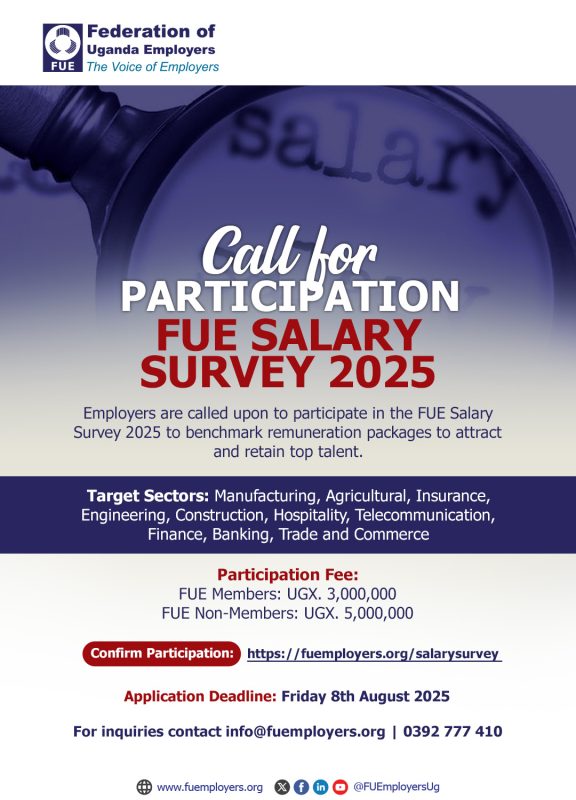
Employers are called upon to participate in the FUE Salary Survey 2025. This survey will provide business leaders with valuable insights on remuneration packages in various organisations within the same sector to attract and retain top talent.
Targeted sectors: Manufacturing, Agriculture, Insurance, Engineering, Construction, Hospitality, Telecommunication, Finance, Banking, and Trade and Commerce
To participate;
FUE Members: UGX. 3,000,000
FUE Non-Members: UGX. 5,000,000
Click here to confirm participation
Application Deadline: 8th August 2025
For inquiries contact info@fuemployers.org | 0392 777 410.
FUE STAFF COMMENTARY
Navigating the Evolving Job Market: Insights from the Budget and Job Market Trends
The 2025/26 Uganda Budget was recently read, marking a strategic pivot toward full monetisation of the economy through commercial agriculture, industrialisation, digital transformation, and expanded service sectors.
We have had the distinct advantage of previewing this fiscal direction through our internal job market insights, gathered from the first six months of 2025 and meticulously tracking industry hiring patterns across Uganda. The powerful convergence of these two datasets provides an unparalleled glimpse into the future of human capital in Uganda, revealing a dynamic shaped by both governmental policy and real-world employer behaviour.
This article, therefore, aims to leverage this unique vantage point, offering forward-looking insights for employers, HR professionals, and policymakers. By marrying the priorities of the national budget with real-time job market trends, we hope to spark timely conversations around talent development, industry growth, and workforce readiness in Uganda’s fast-evolving economic landscape.
The 2025/26 budget underscores the government’s commitment to accelerating socio-economic transformation through key priority areas. Among these, commercial agriculture, industrialisation, digital infrastructure, education, health, and youth employment emerge as top investment avenues.
- Education: With UGX 5.04 trillion allocated, the focus is on scaling access, quality, and employability—especially through TVET reform, teacher training, and new seed school construction.
- Health: The health sector received UGX 5.87 trillion, aimed at strengthening primary care, expanding emergency services, and enhancing e-health systems, creating demand for healthcare and health-tech talent.
- Digital Transformation and ICT: With investments in the National ICT Backbone, the government targets a shift toward a digitally-enabled economy, which has direct implications on the demand for digital skills.
- Youth-focused Enterprise Programs: Over UGX 9 trillion is being injected across PDM, Emyooga, YLP, and UWEP—positioning entrepreneurship as a core employment avenue.
These allocations suggest a policy-backed transition from a consumption-driven to a production-led economy. The implication for human capital is clear: sectors with budgetary prioritisation are likely to see both job growth and skill evolution, calling for targeted skilling, re-skilling, and a tighter public-private alignment in workforce planning.
Job Market Trends and Insights from the first half of 2025;
Our internal market reports (Q1 & Q2 2025) paint a nuanced picture of Uganda’s job market: recruitment agencies dominated listings and a small number of recruitment firms accounted for a large share of job postings, indicating either one or two things, a growing outsourcing trend or an indication of the same listings posted in different job listing channels. The recruitment sector recorded a 4X increase in job listings per employer year-on-year.
Top Hiring Sectors in the first half of 2025
- Healthcare: Driven by post-pandemic recovery and new investments.
- Education and Training: With spikes in private education roles and technical training demand.
- ICT and Digital Services: Tech roles, especially in software, cybersecurity, and IT support, saw sustained demand.
- Finance and Insurance: Roles in digital banking and microfinance were prominent.
- Agriculture and Agribusiness: While less dominant in raw listings, emerging signs of activity around agritech and supply chains were noted.
Skill Trends: Demand for digital literacy, soft skills (communication, adaptability), and technical certifications (especially in health and ICT). An increase in contractual and project-based roles, particularly in the ICT and NGO sectors.
Employer Behaviour: When comparing the first half (H1) of 2024 to 2025, there was a 32% increase in the number of unique employers using digital platforms for job advertisements and hiring. This increase could indicate one of two things: either more organizations are now open to digitising their hiring processes, or there is a growth in new organizations in the market.
However, we observed a decline in job listings when comparing quarterly data. Specifically, Q1 consistently showed more employer listings compared to Q2. Notably, there was a 31% decrease in employer listings in Q2 of 2024 compared to Q1 of the same year, and a 45% decrease in employers posting jobs between Q2 of 2025 and Q1. This trend may suggest that hiring patterns in the Uganda job market are being affected by budget readings that typically occur towards the end of Q2.
This data indicates that while there’s momentum in job creation, especially in sectors like healthcare, education, and ICT, the job market remains narrowly distributed, requiring deliberate efforts to broaden participation, especially among SMEs and regional employers.
Merging the Insights – What It Means for Human Capital; When we merge fiscal priorities with on-the-ground hiring patterns, a few clear themes emerge
- Budget Focus ≠ Hiring Focus (Yet): Notwithstanding the substantial financial allocations to sectors such as agriculture, corresponding employment generation, specifically within commercial agribusiness, continues to be nascent. This demonstrates a temporal disparity between governmental policy objectives and private sector absorption capacity, a phenomenon particularly evident in conventional economic.
- ICT and& Education Alignment: Encouragingly, budget emphasis on ICT infrastructure and education reform aligns with high employer demand for tech and training roles. This presents a ripe opportunity to scale up public-private skilling partnerships.
- Healthcare Surge Continues: With simultaneous investments in health infrastructure and a consistent increase in job listings, the healthcare sector is poised to remain a high-impact employer, especially for community health workers, lab technicians, and e-health managers.
- Rise of Hybrid Recruitment Models: The sharp increase in listings from recruitment agencies, contrasted with fewer direct employer listings, calls for HR innovation. There is a market opening for hybrid recruitment solutions, where agencies and platforms can co-create pathways to improve match quality and hiring efficiency.
Conclusion
Uganda stands at a pivotal moment. The 2025/26 budget provides a strong foundation for economic transformation, one that places people at the centre through strategic investments in health, education, and productivity. Meanwhile, the job market tells us that private sector hiring is active but uneven, and increasingly reliant on intermediaries. As HR leaders, employers, and policymakers, we must now ask: How do we bridge the gap between fiscal investment and talent readiness? By embracing data-driven workforce strategies, accelerating demand-aligned skills, and rethinking employer engagement models, we can unlock Uganda’s full human capital potential. Let’s not wait for transformation to happen; we must design it.
By Douglas Opio and Xenia Wachira
UPCOMING EVENTS
[wpcdt-countdown id=”3878″]