
ISSUE 67 | SEPTEMBER 2024
AN OFFICIAL NEWSLETTER OF THE FEDERATION OF UGANDA EMPLOYERS
FUENEWS
THE VOICE OF EMPLOYERS
FUE CEO MESSAGE

Dear Esteemed Member,
As we transition into the final quarter of the year, we applaud you for your active participation in the work and activities of the Federation.
In the world of work, Environmental, Social and Governance (ESG) principles have become a significant aspect of conducting successful business. The United Nations Principles for Responsible Investment is an international organisation that works to promote the incorporation of ESG into investment decision-making.
ESG criteria are used to evaluate the long-term sustainability and ethical impact of companies, with the goal of creating a more sustainable and equitable future. According to the World Bank’s 2020 report, agriculture employs 25% of the world’s population, with 60 to 70% of low-income countries’ inhabitants in Africa and Asia relying on it. ESG in Agriculture is a crucial framework for assessing an agriculture company’s impact on society and the environment. The adoption of ESG practices in agriculture can help address issues related to Environment, Society and Governance and ensure that the industry operates in a sustainable and responsible manner.
In the Ugandan context, agriculture contributes up to 40% of Uganda’s total Gross Domestic Product (GDP) and over 90% of the country’s foreign exchange earnings according to the Food and Agriculture Organisation of the United Nations. In terms of employment, the agricultural sector employs over 72% of the population to advance economic growth. In a bid to increase Uganda’s GDP, the Government is advocating for commercialised agriculture and mechanized farming to boost productivity, facilitate export promotion and foster import substitution.
This month, we participated in the 5th Bi-Annual Private Sector Retreat hosted by the Presidential CEO Forum. The retreat deliberations involved commercialising agriculture to boost export promotion in Northern Uganda attracting policy makers, political figures, business leaders and other relevant stakeholders. The discussions were significant to create a platform to deliberate on incentives to improve agricultural production, increase value addition and expand into other regional and international markets. As an agricultural dependent county, there is need to ensure agricultural practices are conducted in a responsible and sustainable manner to combat the effects of climate change globally. We remain committed to working with relevant stakeholders to build sustainable enterprises.
Thank you,
Together for Employers.
Douglas Opio
The Chief Executive Officer, FUE
CONTENTS
- FUE CEO Message
- The 5th Bi-Annual Private Sector CEO Retreat
- Legal Compliance And Employee Well-Being For A Thriving Workplace Training
- Employers’ Industrial Relations Clinic
- FUE Conducts Child Labour Due Diligence Training
- FUE-TINKR Norec Partners Meeting
- FUE Member Engagement
- The Employer Handshake
- Strategies To Enhance Workplace Productivity
- Upcoming Events
- Employer Information

THE 5TH BI-ANNUAL PRIVATE SECTOR CEO RETREAT

The Presidential CEO Forum convened the 5th Bi-Annual Private Sector Retreat from 13th to 14th September at Kampala Serena Hotel themed, ‘Battle to Greenfield: Transforming Northern Uganda into a Commercialised Production and Logistical Hub for Export’. His Excellency, President Yoweri Kaguta Museveni was the Chief Guest with the Prime Minister, Members of Parliament, Ministers, CEOs and other stakeholders in attendance. Our Chief Executive Officer, Mr. Douglas Opio, a member of the PCF board represented Employers at the retreat.
H.E. the President in his speech highlighted that Northern Uganda needs full government support through Ministry of Finance to elevate the commercial agriculture in the region. He revealed that the four-acre model was introduced to alleviate the effects of land fragmentation. Mr. Museveni further implored large scale farmers to engage in diversified farming to boost Uganda’s agricultural sector and enhance export trade.
Furthermore, it was revealed that Northern Uganda offers a national opportunity for commercial agriculture with large areas (500 to 10,000 acres) ready for farming. This is significant to large scale farming, boost exports and advance economic growth.
We believe commercial agriculture will boost productivity, improve livelihoods and advance sustainable growth.




LEGAL COMPLIANCE AND EMPLOYEE WELL-BEING FOR A THRIVING WORKPLACE TRAINING
In a dynamic business environment, mastering the delicate balance between employee well-being and legal compliance is a competitive advantage. On 11th and 12th September, we convened a general training at the FUE Training Centre, Kiwanga-Namanve. The topic of discussion was, ‘Legal Compliance and Employee Well-Being For A Thriving Workplace: Uganda Industrial Court Precedents As Guiding Principles’. Participants included Senior and Middle Managers, Human Resource Practitioners, Legal Professionals, C-Suite Executives and Policy Makers among others.
The training entailed real-world insights, expert guidance and practical strategies to promote employee well-being and ensure legal compliance within an organisation. Participants had the opportunity to gain a comprehensive understanding of employee well-being, master Ugandan labour laws and create a positive work culture that is significant to labour productivity and business growth. Employers were advised to mitigate legal risks in daily work operations to prevent litigation and long court processes.
It is expedient for Employers to invest in initiatives that guarantee employee satisfaction, promote occupational safety and health for a conducive business environment.
If you would like a customised training suited to your organisation needs, kindly contact Yusuf Nsubuga, the Training Manager on yusuf.nsubuga@fuemployers.org | info@fuemployers.org




EMPLOYERS’ INDUSTRIAL RELATIONS CLINIC
On 27th September 2024, the Employers’ Industrial Relations Clinic was held under the theme, ‘Termination: Visa vs Case Law from the Court of Appeal’. The clinic was convened at the FUE Training Centre, Kiwanga-Namanve aimed to share expert understanding and guidance on termination that impacts employment law and industrial relations.
The training had an in-depth insight into latest case law and it’s implications for termination practices. Employers were privileged to access tailored advice to address specific challenges and scenarios. In addition, participants connected with industry peers and expand our professional network.
FUE believes that good employment relations at the workplace is vital for workforce productivity, efficient service delivery and smooth work operations. We remain committed to support Employers uphold labour standards and achieve decent work for all.


FUE CONDUCTS CHILD LABOUR DUE DILIGENCE TRAINING
In August 2020, Convention 182 on the Worst Forms of Child Labour achieved universal ratification by all 187 International Labour Organisation (ILO) member states. FUE in partnership with ILO conducted a training on child labour due diligence and documentation of remediation procedures for Employers and other stakeholders from 16th to 19th September 2024 at Mt. Elgon Hotel and Spa, Mbale Eastern Region. Participants included General Managers, Human Resource Practitioners, Field Supervisors and Local Government Officials.
The training provided a comprehensive understanding to apply the ILO-IOE guidance tool in their child labour due diligence efforts. Participants were enlightened on compliance with national legislation to safeguard their organisations from lawsuits due to failure to uphold labour standards. Additionally, best practices on the elimination of child labour such as providing bursaries, scholastic materials and other basic needs for employees were discussed to end child labour by 2030.
FUE is keen on holding Employers accountable in a bid to achieve Target 8.7 of the Sustainable Development Goals (SDGs) to accelerate actions to end child labour globally. We commend the ILO and other partners for their technical support towards efforts to preserve the young generation from exploitation.


FUE-TINKR NOREC PARTNERS MEETING
In a bid to increase skills and knowledge transfer, foster innovation and develop strong networks, FUE commenced a staff exchange program with Tinkr facilitated by NOREC. In September annually, FUE and Tinkr convene a partners’ meeting to evaluate the program and discuss new ideas to increase the benefits of the initiative.
On 9th to 13th September 2024, FUE and Tinkr conducted a review meeting to discuss progress on the staff exchange program in Drammen, Norway. The various benefits that have been accrued in the last two years were deliberated on in addition to the challenges and practical solutions to create an improved experience for the next group of staff that participate in the program. This meeting is significant to ensure the implementation of the objectives of the program.
Furthermore, Our Chief Executive Officer, Mr. Douglas Opio had the opportunity to engage with a representative of the EU Affairs Confederation of Swedish Enterprises to discuss pertinent issues on benchmarking services to members and sectoral associations.
We encourage Employers to conduct job rotation and collaborate with other organisations to conduct work exchange programs. This will boost workforce productivity, enhance efficient service delivery and build strong entities.

FUE MEMBER ENGAGEMENT
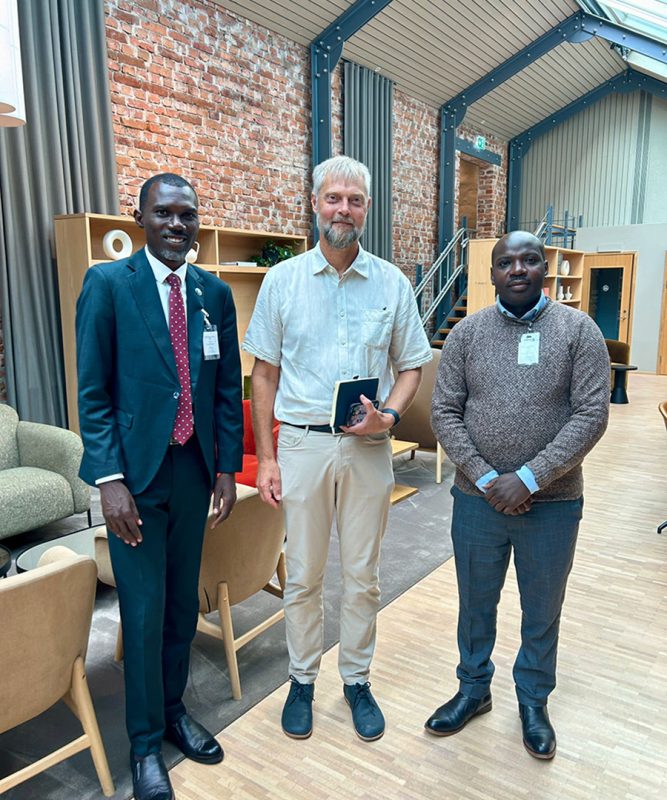
Our Esteemed Member, Uganda Insurers Association (UIA) upgraded to the Platinum membership category. We applaud UIA for taking this milestone. A higher membership category is equal to higher benefits.
If you would like to upgrade your membership category, reach out on info@fuemployers.org | 0392 777 410 for inquiries.

The Employer Handshake
Sign up today for FUE membership to enjoy an array of benefits.
To become a member, contact info@fuemployers.org | 0392 777 410.
FUE STAFF COMMENTARY
STRATEGIES TO ENHANCE WORKPLACE PRODUCTIVITY
“Productivity is never an accident. It is always the result of commitment to excellence, intelligent planning, and focused effort”, says Paul Meyer, the founder of Success Motivation Institute (SMI International) and one of the world’s most outstanding authorities in the fields of goal setting, motivation, and professional development.
Labour productivity is the heart and soul of any organization. An organization that invests to improving their employees’ productivity levels would reap the benefits that results from such an investment. Increase in production and revenue, improved customer service, better collaboration and engagements, higher retention rates, stakeholders’ satisfaction, and business competitiveness are some of the benefits that can be realized when a workplace productivity increases and remains high. However, many organisations often struggle to achieve the desired level of productivity.

Indeed Editorial Team (2024) defines Productivity as the amount of work an individual or group accomplishes within a certain amount of time. Greater productivity means you complete more tasks with less time or effort. In this regard, accomplishments are measured by the quality of the work, the number of tasks finished or the amount of product created. According to Quixy Editorial Team (2023), workplace productivity is the efficiency and effectiveness of individuals and teams within an organization in accomplishing tasks and achieving goals within a given timeframe.
There are four types of productivity at workplace. These include; labor productivity which measures the output per worker or per hour worked. Labor productivity can help you see whether each team member is being productive enough; Capital productivity measures how well your team is using physical capital to produce goods or services; Material productivity measures the level of output against the amount of raw materials used; and Total factor productivity or multifactor productivity measures productivity by taking into account a number of factors – capital, material, labour productivity, plus other factors like management style, knowledge, and the organizational structures, and how they affect the organisation’s output (Qualtrics, 2024).
In order to maximize workplace productivity, you need a clear plan for what and how things need to done to achieve a certain goal while bearing in mind the four pillars /principles of productivity which are; task management, prioritization, time management, and focus. According to PeoplePointHR, a specialist provider of Human Resources (HR) outsourcing and Employment Law advice in Britain, and Indeed Editorial Team – the professional writers and researchers that cover insights and trends in the modern worlds of work and Human Resources in USA, plus other industry experts, workplace productivity can be increased through implementing the following strategies;
- Clarify and emphasise on quality over quantity. Efficiency does not necessarily mean just completing as many tasks as possible in a given timeframe. Instead, the work being completed should offer value to the clients receiving it.
- Provide constructive feedback and support for improvement when employees are not performing as well as you would like them to. Everyone needs feedback to improve performance and mend mistakes.
- Avoid multitasking as it often leads to mistakes and slower completion times. A number of studies have shown that multitasking can negatively affect an individual’s productivity by as much as 40%.
- Communicate clearly, frequently, and meaningfully with employees on individual, team and organisational goals. Each individual needs to understand fully what they and their team are working towards.
- Recognize and reward your most productive workers. A tried-and-true way to re-engage workers is through appropriate and timely recognition for their good work, which can foster a more profound sense of achievement, belonging and connection.
- Offer incentives for employee performance and improved productivity. Simple incentive schemes have been proven to be very influential on the employee productivity levels.
- Provide training and development opportunities to help employees show consistent career growth.
- Respect your employees and their work. This may seem to be straightforward but it’s often an issue for lower level employees in large organisations.
- Promote a positive and healthy work environment in which employees can feel safe, engaged, and inspired. According to Gallup, highly engaged teams are 21% more productive than those with low engagement.
- Identify and minimize time-wasting activities. Holding meetings for the sake of meetings is not productive. Weekly and daily meetings could negatively affect productivity.
- Give your employees autonomy by providing flexible working arrangement, and letting them set meaningful goals for themselves in alignment with your organisation’s objectives.
- Challenge employees appropriately by increasing accountability, and responsibility within reason, when the time is right.
- Help your employees understand why their work matters by giving them a sense of purpose.
- Hold one-on-one meetings to understand the issues that affect employees’ productivity which may not be said during staff meetings.
- Promote collaboration and teamwork. The most successful businesses encourage collaboration and teamwork on a regular basis.
- Match tasks to skills. One reason an employee may be struggling with their productivity is because their tasks are too challenging, which can cause them to take longer to complete their work.
Therefore, improving workplace productivity is not something that can change overnight. It requires a clear understanding of the current productivity levels so as to design well thought out and meaningful strategies to improve, since employees’ performance levels vary regardless of the workplace. While some employees are faster in accomplishing some tasks yet they do so hurriedly and carelessly with quality issues, others are slower but more thorough. Yet others manage to achieve the desired level of productivity – fast, and good quality work. Similarly, some other employees can be highly productive, yet extremely difficult to work with, which is not necessarily a benefit to the organisation. So, the focus should be to try and strike a balance of the two things – quantitative and qualitative factors. While quantitative factors provide measurable data (number of tasks accomplished), qualitative factors offer insights into customer satisfaction and employee engagement. Providing significant value to the clients/customers in the end product or service is paramount for sustained business success.
By Patrick Ajuna, Policy and Research Officer
UPCOMING EVENTS
[wpcdt-countdown id=”4889″]


Employer Information
Employers are hereby informed that the Governmnent has extended the National Identification cards by one year. Kindly click the link below to view
For inquiries contact info@fuemployers.org | 0392 777 410.